Not on sale yet
It runs inside NinjaTrader. You never type a thing.
Ballast reads your accounts directly. It knows what your firm's drawdown rules are, how much room you have left on every account right now, and what you were looking at when you clicked buy — because it photographs the chart. The only thing it asks you for is the one thing software cannot see: whether the trade was your plan.
Every image below is captioned. They are illustrations rendered from the add-on's own source, so the layout, the colours and every word in them are the ones it really puts on screen. Nothing here is a concept. Setup has been rebuilt since the last photograph was taken, so rather than show you the old one there is no image of it below — a current one goes up when it is taken.
The Now tab
One number decides whether the account survives
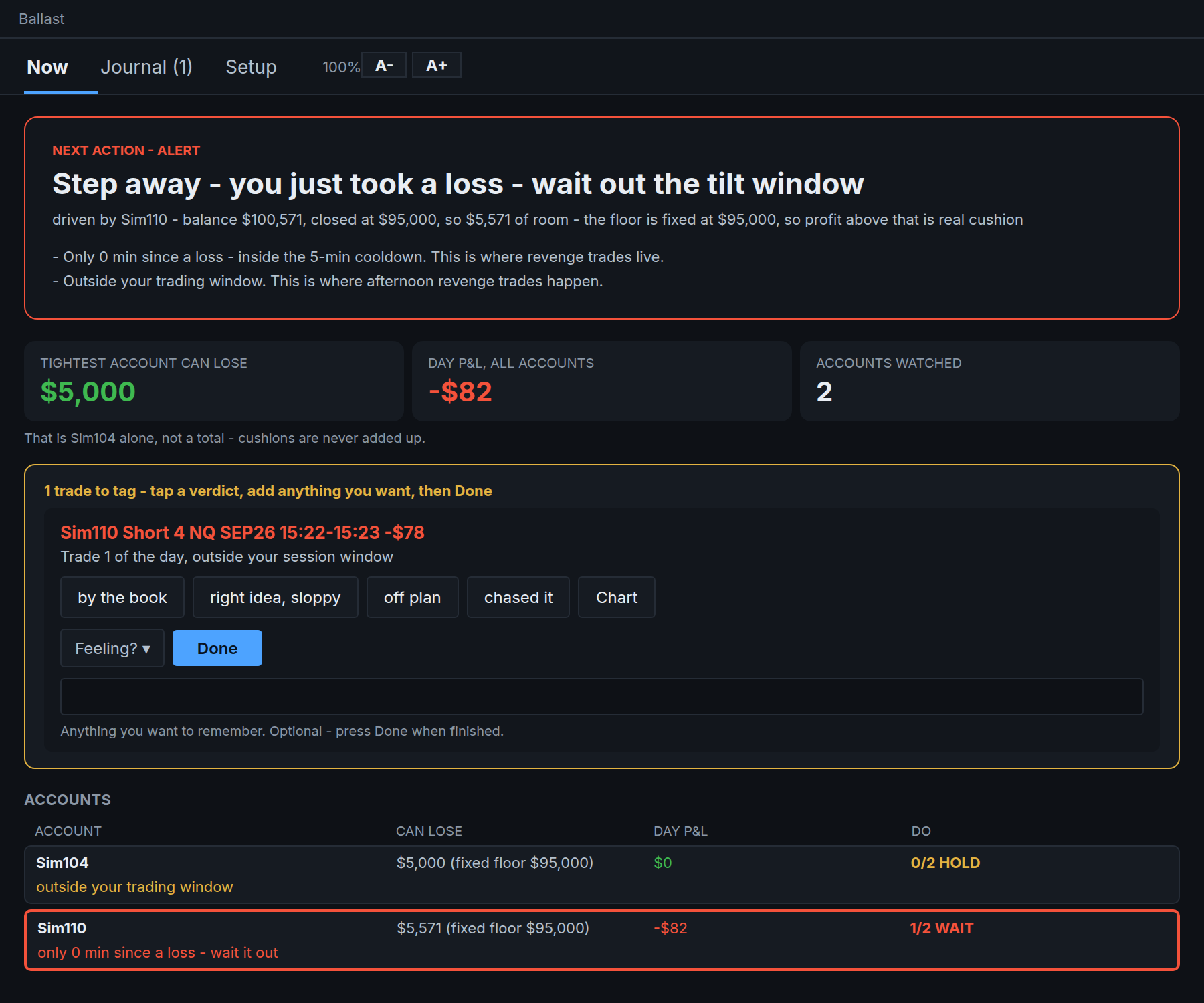
Not your balance — the distance between your balance and the level your firm closes the account. Ballast tracks that live on every account at once, knows the difference between intraday and end-of-day trailing, and knows that most firms freeze the floor once you pass a threshold.
The headline is driven by whichever account is in the most trouble. Every other account still speaks for itself underneath — “was up $800, handed back $600 — do not trade back your profits”. Six accounts open used to mean five of them were four numbers and a code.
When you are tilting
It takes the screen away. It never touches your orders.
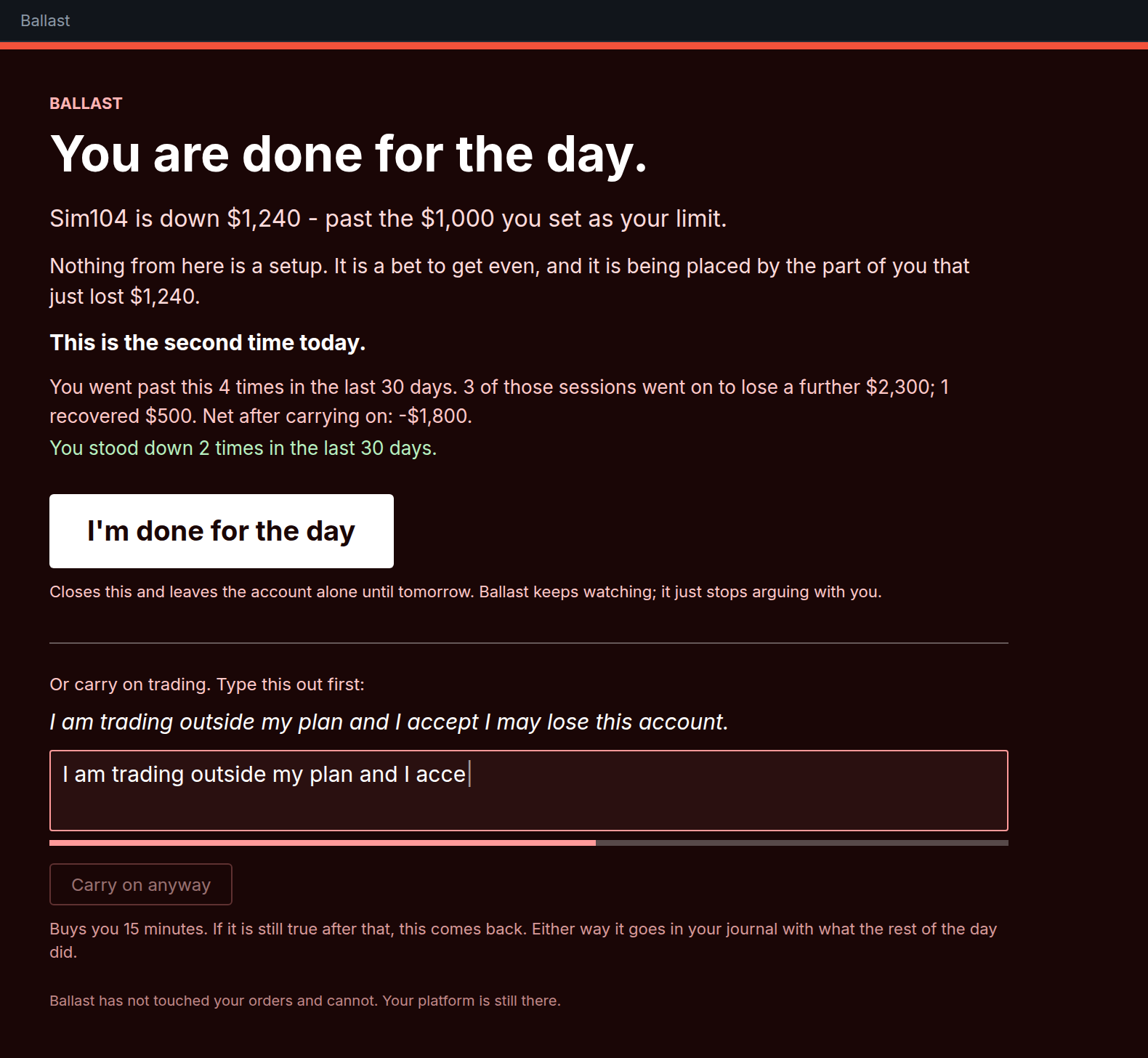
Every trader knows the feeling. You are down, and the next trade stops being a trade and becomes an attempt to get the money back. Nothing on a dashboard has ever stopped that, because in that state you are not reading dashboards.
So when an account goes past its floor, past your daily loss limit, or past the number of losses you set as your line, Ballast covers its own window — every tab, all of it — and says the thing in your own numbers. “Nothing from here is a setup. It is a bet to get even, and it is being placed by the part of you that just lost $1,240.”
“I'm done for the day” is one click. Carrying on means typing out “I am trading outside my plan and I accept I may lose this account.” That is about ten seconds, and you cannot paste it. Ten seconds is roughly how long it takes for an impulse to stop being automatic and start being a decision — which is the entire mechanism. The right choice is easy on purpose and the wrong one is slow on purpose.
Then it is written down. Every override is logged with your P&L at that moment and what the rest of the day actually did, so the next time the wall appears it stops arguing and shows you your own record: “You went past this 4 times in the last 30 days. 3 of those sessions went on to lose a further $2,300; 1 recovered $500.” It counts the times carrying on worked out, because a record that only ever reported losses would be worthless the first time you checked it. It counts the times you stopped, too.
The Journal tab
The journal fills itself in
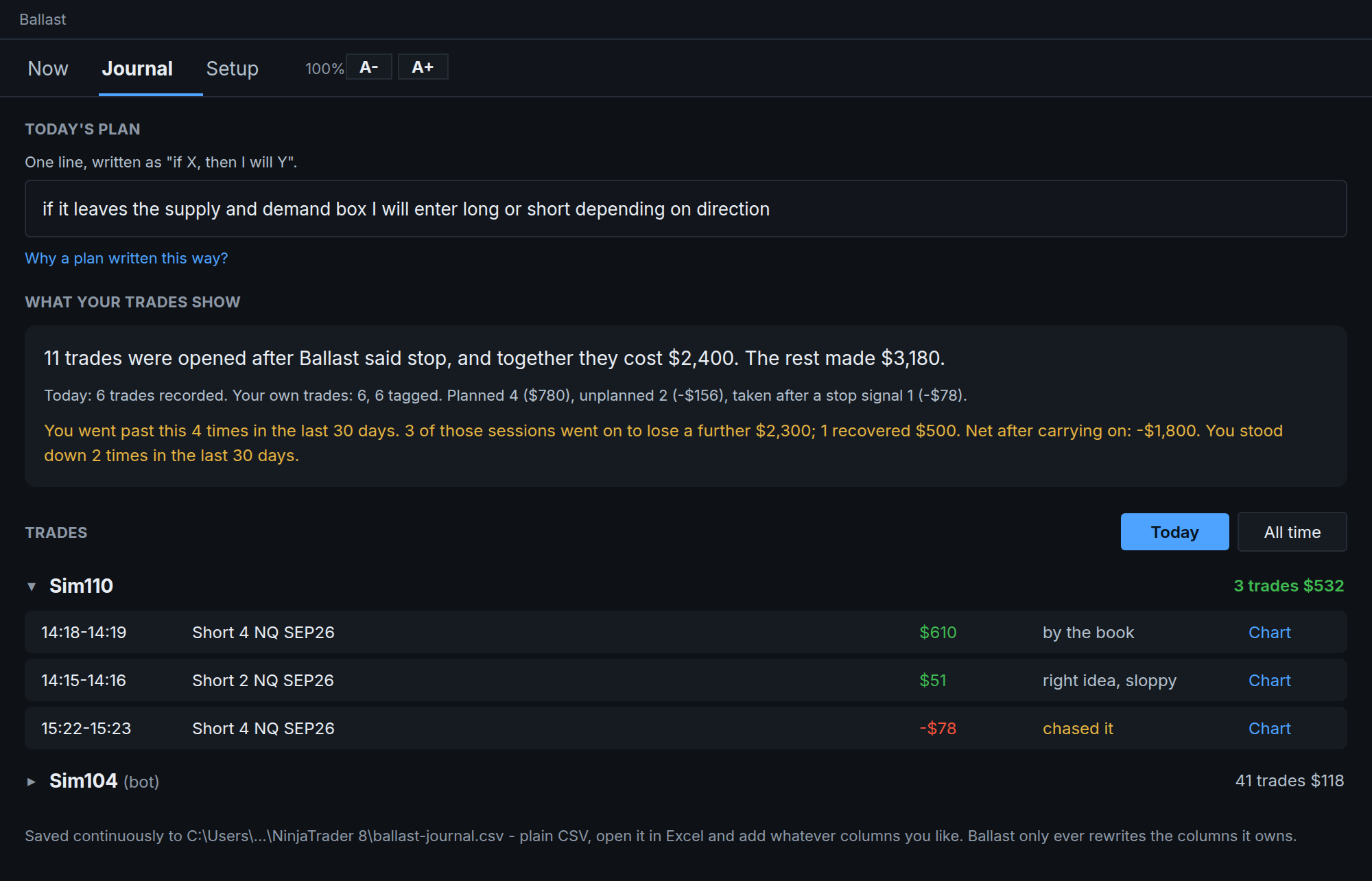
Every round trip is recorded the moment you go flat: instrument, direction, size, entry and exit times, duration, P&L. Nothing to look up. Nothing to retype. That mechanical copying is what kills journals in week two.
You name your own setups once — call them A, B and C, or name them properly — and every trade in the journal carries a picker for which one you took. That is what turns a pile of trades into an answer about your entries rather than a diary.
It also records what no other journal has — what Ballast was advising when you opened the trade, your cushion at that moment, and how many minutes it had been since your last loss. All machine-observed, so it works even if you never tag anything. That is how it can eventually tell you something like “11 trades were opened after Ballast said stop, and together they cost $2,400.”
It asks one question a machine cannot answer
After every trade: did you move your stop or your target? One tap — held both, moved my stop, moved my target, moved both — and if you moved something, the note box changes to ask why, while you still remember.
Ballast watches your position, not your working orders, so this is genuinely invisible to it. It is also the break that costs the most: a stop moved away turns a planned loss into an unplanned one, and a target pulled in turns a winner into a scratch. Answering it turns the most expensive habit in trading into something with a number attached — “the 4 trades where you moved your stop or target cost you $1,200; the 6 you left alone made $1,080.”
Trades you do not answer count as neither. A journal that assumed you held would flatter you, and that is the one thing it must never do.
Setup
Every account gets its own rules, on its own page
Tick an account and Ballast reads the firm from the account name and the size from the balance, then applies that firm's published drawdown, drawdown type and floor-lock level. Apex, Topstep, Take Profit Trader, MyFundedFutures — evaluations and funded accounts separately, because they do not behave the same, and legacy sizes separately, because they do not either.
Setup is two pages now, not one. A list of your accounts, and behind each one its own page of rules— daily stop, trade count, losses in a row, target, size, trading window. Click “set its rules” and that account is in front of you, named at the top, with every field on the page belonging to it and nothing else. A trader running six accounts across two firms does not have one set of limits, and the old single page pretended he did.
One thing came out rather than in. There used to be a button that matched every account at once by balance, and a setting above it asking which generation of account you hold. Both are gone. A single answer to “which generation do you hold” cannot be true of a person, only of one account at a time — a legacy 50K trails $2,500 against a 4.0 50K's $2,000, a balance cannot tell them apart, and you can hold both at once alongside accounts at other firms entirely. Each account states its generation when you pick its type, and there is a per-account override if a label ever lies.
Each account also says what it is for — practice, evaluation, or funded. That is not the same question as whether the platform calls it a simulator: plenty of traders run a sim deliberately as though it were funded, to test a strategy under something like real conditions. Only you know which, and it decides what the comparison further down this page is actually measuring.
It refuses to guess. A balance that matches no standard size is left for you to fill in, and an account whose purpose you have not stated is left out of the analysis rather than guessed at. The rule book updates itself from this site, so when a firm moves a number your cushion follows without you doing anything.
What the journal gives back
A journal nobody reads is just tagging
This is the failure mode every trading journal dies of, and admitting it is the only way past it. You answer a question on every trade for a week, and you never open the page where the answers add up. The tagging is a cost you pay daily for a benefit you never collect.
So Ballast does not wait to be opened. When your trading day ends — your window closes, or you press “I'm done for the day”— it puts the day's strongest finding in front of you, and it does the same before your first trade of the next session, when it can still change a decision. Not “would you like to review your journal”, which is a question with an easy no at the end of a losing day. The finding itself: “The 3 you took off your plan cost $650. The 4 you took by the book made $500. That is the whole day.”
It picks what to say by how actionable it is rather than how big the number is. Execution first, because “stop chasing” is an instruction you can follow tomorrow morning. Then which setup is carrying which. Then the feeling that only ever loses. And if none of those can be said honestly, it reports the day and no more — a sentence that overclaims on a three-trade sample is how a journal starts lying to the one trader who finally began reading it.
Do your entries work?
Your own setups, worst money first, net of commission, over today, this week, this month or the year. This is the question you cannot answer from memory: the setup that feels like it works is the one whose wins are memorable, and memorability has nothing to do with money. Where the sample is too thin to mean anything it says so instead of pretending.
What changes when the money is real
The only controlled experiment you ever run on yourself — same person, same setups, same market, same hours, one variable moved. Ballast compares how you trade a practice account against how you trade a funded one: rule-breaking, how long you hold winners against losers, how fast you re-enter after a loss, trades a day, size.
Behaviour, never money
A simulator's fills flatter you — no slippage, no queue, limits that fill when they would not have. So a P&L gap between practice and funded is part psychology and part generosity, and nobody can separate the two. No fill engine decides whether you chased, or whether you held a winner to target. That is the person, and it is the only honest ground for the comparison.
It changes the tool, not you
Ballast is not qualified to tell you about your own head and does not try. What it does is point at a number in your own settings that would have changed the outcome: “Across 10 days your first 3 trades made $4,500. Everything after that gave back $5,500. Your limit is 12.” One button applies it. Nothing changes unless you press it.
The chart indicator
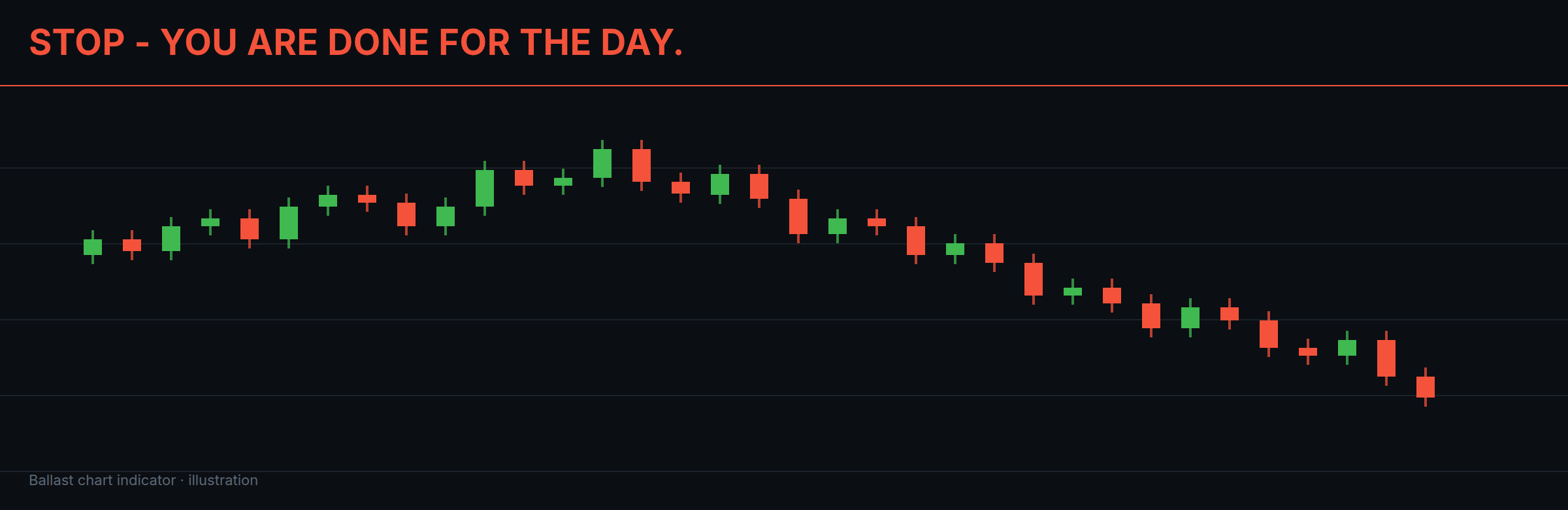
The warning goes where your eyes already are
A panel off to one side is exactly where nobody looks in the second before a revenge trade. Ballast ships a companion indicator that puts the same message on the chart itself — in a strip of its own, beneath the price panel, the way volume sits.
The strip matters more than it sounds. A real trading chart is the most contested space on the screen: your platform lists every indicator's name across the top, the instrument watermark sits in a corner, and a chart running eight studies has a wall of coloured text before Ballast draws a character. Making the warning bigger or redder does not win that fight, it just adds to the pile. So it stops competing. Nothing else can draw there, so it can never be buried, and you always know exactly where to look.
On a quiet day it is a quiet line — trades taken against your limit, losses in a row, what is left of today's budget, the room to your floor. When an account goes past a hard line the strip fills red. It reads whichever account the chart's own order entry is set to, so switching a chart between accounts moves Ballast with it and there is nothing to configure. And it draws nothing at all if the data is stale, rather than confidently showing you an hour-old “you are fine”.
A hard breaker is the one thing it will not stay quiet about. Turning the lockout off, or typing past it, buys you silence inside Ballast — it does not buy a clean-looking chart.
It photographs the chart at entry and at exit
Everything else in a journal is a number, and numbers are easy to argue with afterwards. “The setup was there.” “It looked different at the time.” Memory of your own reasoning is not retrieved, it is rebuilt — and it gets rebuilt to fit the outcome.
A picture of what was actually on your screen ends that argument. It is the one field hindsight cannot rewrite, and it costs you nothing: no screenshot key, no cropping, no filing. Both images sit in the journal, and any trade opens as a full page with every figure Ballast recorded underneath.
What it deliberately does not do
It never touches your orders.
Ballast does not place, modify or cancel an order, and never flattens a position — not even behind the lockout. The wall covers Ballast's own window; your platform is one Alt-Tab away and always will be. Software that closes positions costs real money when it is wrong, and this has not earned that trust yet.
It does not tell you what to trade.
No signals, no setups, no entries. It watches how you behave around the trades you already take.
It does not guess at your numbers.
Where a figure is not verified against the firm's own page, Ballast assumes the conservative version — reporting less room than you may really have. Being cautiously wrong is survivable. The opposite is how accounts die.
Not for sale yet
It works, it runs live, and it is being traded on every day. It is not finished. Leave your email and you will hear when it is — and nothing else in the meantime.
In the meantime the trailing-drawdown cushion calculator is free and needs no signup.